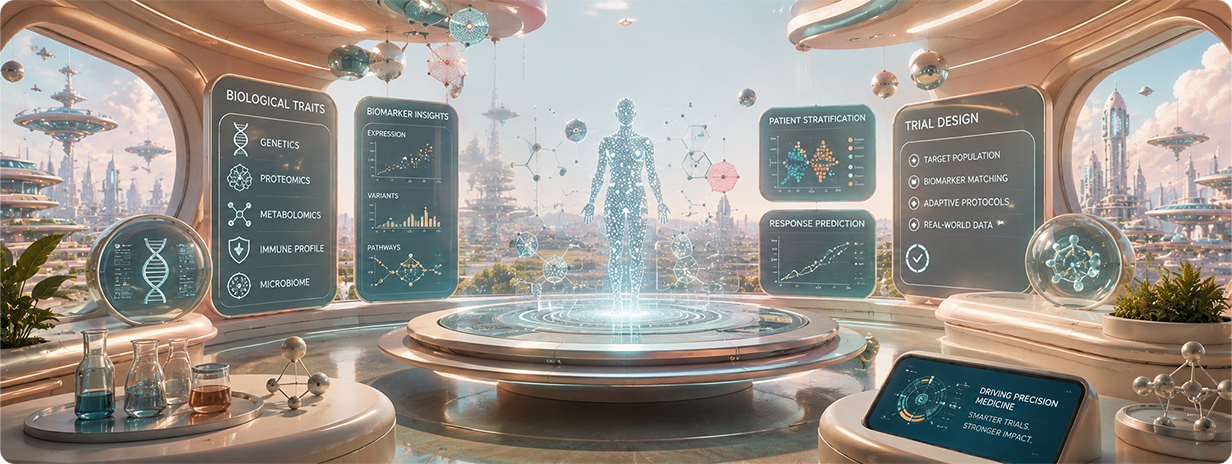
Consider the following scenario from 2034: A 32-year-old man mentions occasional balance issues during a routine doctor’s visit. It’s nothing dramatic: He hasn’t fallen and he still exercises regularly. But over the previous 18 months, his health system has quietly accumulated a dense stream of longitudinal data.
It has registered subtle changes in gait from smartphone accelerometers and a slight slowing in speech cadence during voice interactions. It has noted increasing sleep fragmentation from wearable data as well as small but measurable shifts in inflammatory and metabolic biomarkers. It has identified tiny retinal abnormalities visible only through machine vision systems trained on millions of scans.
Individually, none of these signals would alarm a physician. Together, they form a pattern. Inside a large-scale disease simulation platform, the patient’s profile is compared against billions of synthetic disease trajectories derived from real-world clinical, genomic and behavioral data. The system does not produce certainty because medicine rarely does. Instead, it generates something closer to a probabilistic forecast.
The model estimates a high likelihood of developing a neurodegenerative disorder within the next five years. But it also produces a more surprising conclusion: That the patient is unusually likely to respond to a therapeutic approach that has not yet entered human trials. In other words, that a drug that technically does not yet exist would probably treat him.
How can the system make that call? Because millions of virtual patients biologically similar to him have already been simulated in virtual clinical trials.
Different molecular compounds have been stress-tested computationally across thousands of disease pathways. Failure modes have emerged and toxicities have been modeled. Dosing schedules have evolved through recursive experimentation.
By the time the actual medicine reaches that 32-year-old patient, most of the “trial” has, for all intents and purposes, already happened. And the unsettling thing is that this future no longer feels far-fetched.
Pharma leaders largely welcome the changes. “Having spent much of my career working across drug development, healthcare delivery and patient access, I’ve seen firsthand that many of the barriers to innovation are no longer purely scientific,” says Anand Reddi, global head of direct-to-consumer innovation and digital health at BeOne Medicines. “Increasingly, the challenge is determining how to generate evidence faster, identify the right patients earlier and translate unprecedented amounts of data into better decisions.”
As modern medicine has evolved over the years, bottlenecks have traditionally been related to scientific understanding. We did not know enough biology to intervene precisely and effectively. Autoimmune disorders were giant black boxes with vague names and inconsistent outcomes. Cancer was, well, cancer.
In the current era, the bottleneck is increasingly simulation. We possess astonishing amounts of biological information, ranging from genomic sequencing and longitudinal patient records to biomarker datasets and environmental exposure patterns. The modern healthcare system is less like a hospital network and more like an enormous sensor array accidentally built over decades.
The problem? That humans are terrible at integrating information at that scale. Physicians can only reason through dozens of variables simultaneously, or maybe hundreds in extraordinary situations. Biology, however, operates across millions of these variables.
Thus medicine was forced to develop coping mechanisms. Clinical trials became the gold standard not because they were perfect, but because they shoehorned complexity into a format that could be reasoned with. There were randomized cohorts, narrow inclusion criteria and isolated endpoints. The systems were small enough that statistical inference remained manageable.
This worked remarkably well for a long time, but it came with enormous costs. A modern therapeutic, after all, can take more than a decade and billions of dollars to reach the market. Also, many diseases remain commercially impossible to pursue because trial recruitment is too difficult or patient populations are too small. Entire clinical programs collapse because of operational friction rather than scientific failure.
“Clinical trials remain the foundation of evidence generation, but they were designed for a world with far less data than we have today,” Reddi notes. “Increasingly, the bottleneck is not scientific discovery; it is execution. If simulation can help us ask better questions, identify likely responders and design more efficient studies, we have an opportunity to accelerate innovation without compromising scientific rigor.”
So quietly, without fully or openly acknowledging it, medicine started simulating reality to survive. Researchers use surrogate endpoints instead of waiting decades for mortality data. They model progression curves and extrapolate subgroup outcomes. And now they use AI systems to predict protein structures, identify biomarkers and estimate therapeutic response.
The line between “real” experimentation and simulation has been dissolving for years. Most people just have not come to grips with it yet
A useful comparison may be aviation. Early pilots distrusted simulators intensely, and with good reason: Flying an actual aircraft felt categorically different from sitting in a machine on the ground. Without real danger and turbulence, the stakes felt insignificant.
Then the simulators got much better. While they fell short of perfect, they became good enough that training in actual aircraft started looking inefficient, dangerous and bizarrely expensive.
Is medicine approaching a similar transition? Imagine a pharmaceutical company in 2040 preparing to test a new oncology therapy. Before recruiting a single patient, the therapy runs through 10 million simulated humans constructed from real world multimodal datasets. The company tests different dosing regimens, adherence failures, genomic mutations, combination therapies, ethnic subpopulations, comorbidities, environmental factors and long-term progression pathways. It does so not because the simulation understands biology perfectly, but because, at sufficient scale, prediction itself becomes useful.
This is the part that makes people uncomfortable. Medicine carries a deep cultural suspicion toward abstraction and physicians have long been trained to trust direct observation. Evidence-based medicine, in fact, emerged specifically to fight centuries of overconfident theorizing detached from reality.
Yet human clinical trials are themselves profoundly imperfect abstractions. Trial populations are unnaturally clean, patients are unusually adherent and minority populations are underrepresented. It’s also worth restating that real-world behavior often diverges dramatically after a drug is approved.
In some situations, future simulations may generalize better than traditional trials simply because they model messier reality more comprehensively. That’s not because simulations are magical, but because reality sampled broadly can outperform reality sampled narrowly.
This has happened before in other fields. Chess engines stopped trying to imitate human reasoning and became stronger than humans anyway. Weather systems became directionally reliable long before atmospheric physics was perfectly solved. Autonomous vehicles improved not by “understanding” driving, but by processing incomprehensible quantities of edge-case experience.
In each of these cases, the systems became useful before they become intuitively satisfying. Biology may well follow the same path.
At first, regulators will move carefully and simulations will augment physical trials rather than replace them. Oncology will likely accelerate quickly due to the richness of biomarker data and the enormous economic incentives involved. Rare diseases may become the first major proving ground, because conventional studies are already so difficult.
Only then will virtual control arms become normal, followed by hybrid computational trials and fully adaptive simulations guiding therapeutic development in real time. Eventually people may realize that the center of medicine quietly shifted from observing biology to modeling it.
Which raises an unsettling possibility: That the future of medicine may not be primarily discovering drugs. Perhaps it may be constructing increasingly accurate mirrors of reality and experimenting safely inside them first.
If that sounds strange, it is worth remembering that, over time, civilization has advanced by building simulations sophisticated enough so that physical experimentation became secondary. Engineers don’t crash airplanes into mountains to test safety and architects don’t construct skyscrapers to see whether they collapse. We simulate first because reality is expensive.
Human biology may simply be the next domain where this becomes unavoidable. And somewhere in the future, a physician may diagnose a patient using a therapy that was effectively validated millions of times before any human being physically received it.
Patients will likely never imagine that a simulation helped usher them toward diagnosis. They will simply think of it as medical care.
“The goal is not to replace patients, physicians or traditional clinical research. The goal is to make every patient contribution more meaningful,” Reddi stresses. “If virtual models allow us to test more hypotheses, learn faster and design smarter studies before the first patient is enrolled, we may be able to bring better medicines to more people in less time.
“Ultimately, patients won’t care whether an insight originated in a clinic, a laboratory, or a simulation. They’ll care whether it helped them live longer and better.”
Do you believe that virtual clinical trials can eventually help ease medicine’s execution bottleneck? Drop us a note at hello@kinara.co and subscribe on the website to receive Kinara content.