As CEO of Vertex Pharmaceuticals, Jeff Leiden engineered one of the most remarkable transformations in recent biotech history. Under his leadership, Vertex became one of the rare companies able to repeatedly discover, develop and commercialize breakthrough medications. In so doing, it earned a reputation for sustained innovation in an industry that all too often defaults to the tried-and-true.
In this Q&A excerpt from his lengthy, candid podcast conversation with Kinara co-editor Chase Feiger, Leiden – now Vertex’s executive chairman – discusses the company’s deliberate move away from a shots-on-goal approach to drug development. He also reveals details of the tactical and strategic shifts that led to the creation of the groundbreaking non-opioid pain medication Journavx.
(This Q&A has been lightly edited for length and clarity. To watch or listen to the full Kinara podcast with Jeff Leiden, click here.)
***
Chase Feiger, M.D.: From your perspective, what are the biggest reasons innovation fails in biotech and pharma?
Jeff Leiden, M.D., PhD.: The question of the innovation dilemma is so fascinating, because you have to start by looking at the data and asking, “Is there really an innovation problem in this industry?” Back in 2010 or 2011 when we started to look at this, there was clearly a big problem. I’ll give you a few numbers as examples.
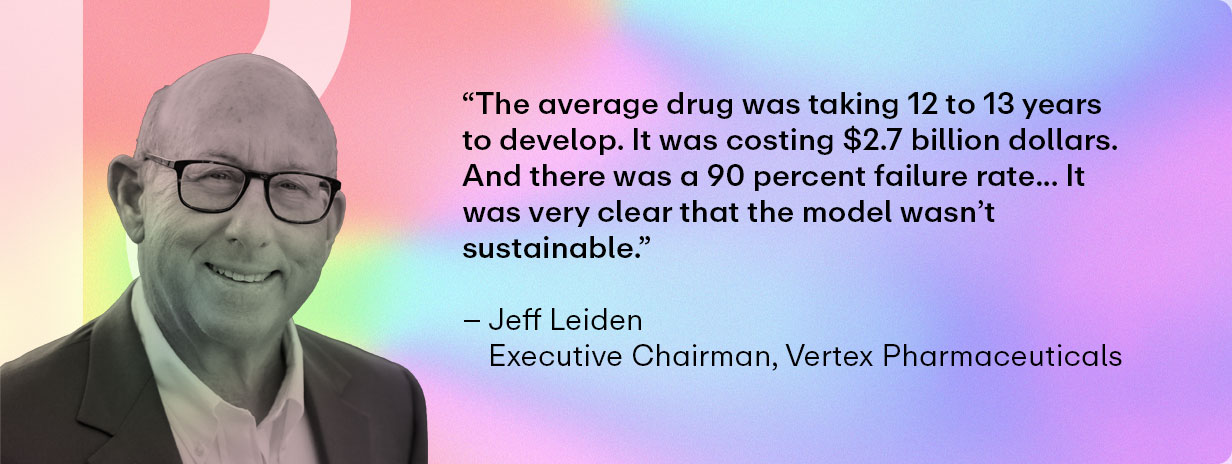
The average drug was taking 12 to 13 years to develop. It was costing $2.7 billion dollars. And there was a 90 percent failure rate, much of that coming in late-stage development after hundreds of millions of dollars had been spent on compounds. It was very clear that the model wasn’t sustainable, and it was all moving in the wrong direction.
Costs were going up. Time was going up. Success rates were going down. So we started off by asking, “Why is this happening?” Because for 40 or 50 years, this industry had an incredible track record of producing transformative drugs, and it was slowing down. It was stopping. It was getting more expensive. We couldn’t succeed under those circumstances.
So a group of us here at Vertex tried to understand this history and understand what the problem really was before we tried to solve it. We came up with seven potential causes or contributory causes. There were probably more, but we thought that these seven were the most important.
The first one was that most of us asked, “Why do most drugs fail?” The thinking in the industry at the time was, well, they fail because they’re not safe or they’re not potent enough or they’re not hitting their target. That turned out not to be true. By 2010, most drugs were failing because they were aimed at the wrong target. The analogy I always use is that it was like throwing darts at the wrong dartboard.
The second thing was a lack of consistency and commitment. What would happen in many big pharmas or biotechs is people would work on these hard problems for two or three years and they wouldn’t get anywhere. Then they’d go, “Okay, we’re going to stop working on cardiovascular disease and start working on respiratory disease. We’re going to stop working on cystic fibrosis and start working on muscular dystrophy.” The thing is, it takes more than two or three years to solve these problems, so this continuous movement was a real problem.
It was made worse by the fact that you had all this leadership change at the top. The CEO of the company was gone in three years. The head of R&D was gone in four years then the new head of R&D had a new set of priorities. It was sort of like the kids following the soccer ball all over the stadium.
Then there were some other things like scaling challenges, particularly in manufacturing. You often made drugs at small scale for clinical trials, so you had to scale up. That could take two or three years and tens of millions of dollars, which slowed the whole process down.
And then once you got there, you got into these other two problems. One was what I call the fast-follower problem, where somebody works for 10 years to make a new class of drugs – you know, the first statin. And it’s a pretty good drug, but it’s not a perfect drug. And then they stop. Pretty soon three other companies come into the space and they put the first person who did all the work and made all the investment out of business.
That happened to us at Vertex. The first drug at Vertex was this really novel molecule for treating hepatitis C. It was a real breakthrough. We worked on it for 12 years and doubled the cure rates. The drug was the fastest drug ever to $1 billion – and then we got out-innovated literally a year later by Pharmasset Gilead and we went to zero. We actually had to take the drug off the market because we stopped innovating. So the notion of stopping the innovation at the first molecule was just deadly for us and we had to fix that.
The final thing was this failure to integrate internal innovation, which is your own research efforts, with external innovation, which is business development. Most companies had an internal research effort that was working on diseases A, B, and C, and they had a business development group that was licensing molecules for diseases X, Y, and Z. There was no integration. When they licensed something in, the internal team said, “Hey, we don’t want that because it’s going to take away from our budget.” So this disconnect between internal and external innovation created a very weird dynamic.
Feiger: Tell me about the moment that you realized the existing model just wasn’t going to work. Was it a single moment or a set of moments?
Leiden: The epiphanies came from watching the industry but also watching Vertex. Obviously the success and failure of Incivek, the hepatitis-C drug, that’s an epiphany. When that happens to you in a company, it is a moment of crisis where everybody goes, “Uh-oh. What just happened?”
It’s not as if we were the only ones who understood there was a problem; the industry clearly understood there was a problem. But what was interesting to me at that time was that the industry’s response was just to start more programs.
Feiger: More shots on goal.
Leiden: Yes, more shots on goal. People would literally talk about that: “More shots on goal, that’s all we need.” And they spent a lot more money with more shots on goal, but the problem was it didn’t scale. The failure rate kept going up and up and up. The expense went up and up and up, and they didn’t end up with more drugs.
By the way, that was true at Vertex too. We had 23 programs in different diseases at that time. And I was looking at that going, “No, that’s just not going to work.” So we better get back to first principles and come up with a way to increase the probability of success and shorten the timelines. That’s the answer.
Feiger: How have you and [Vertex CEO and president] Reshma [Kewalramani] created a culture that centers around this concept of no complacency and continuous serial innovation?.
Leiden: We call it constructive paranoia, and it goes back to our Incivek experience, which was crushing. We were so excited about this new medicine that doubled the cure rates of hepatitis C and all these patients were using it, and then there was this moment when we realized, “Oh, we stopped innovating. We just got out-innovated, and this thing is gone.” That was a very negative experience. But for the future of the company, it was actually a very positive experience.
So on one hand, it created this constructive paranoia. But on the other hand, our feeling is that the really hard part is cracking the biology. The first time you crack the biology on a program and make the first drug, that’s really, really hard. Making Kalydeco, the first CF medicine – that took years. But once you crack the biology, you can do it again and again and make better and better products. We always remind our teams of the competition, because everybody jumps in once you’ve had the first success. “We’re watching companies A, B and C. They’ve now got a CF program. We better go faster.”
Of course, the irony is that the first company has a tremendous advantage. You’ve spent all this time and money to develop expertise around the disease. You are better than any competitor because you have the assays. You know what the drugs have to look like. You have the biologists. So the fact that those companies stopped innovating made zero sense to me, because they actually had a competitive advantage. It’s just that they went on to the next drug, and we just don’t do that.
So if you look at CF, we have five medicines now, each one better than the other. If you look at pain, we have the first one and we have six coming behind it, and we’re excited about taking them into the clinic to see which one is best. In a way, it’s easier to accelerate than to stop.
Feiger: Journavx works by actually cutting the pain signal on the road before it gets to the brain. If this new class of pain meds delivers on its promise, how can it change the way physicians treat pain and how patients experience pain management?
Leiden: Journavx was approved for acute pain, so think about post-surgical pain, injury pain, accident pain, those sorts of things. Before, for severe acute pain, many times generic opioids were the first medicine that physicians tried because they had to provide some kind of relief. Now, before you go to opioids, you want to use a drug like Journavx because it doesn’t have the addiction potential.
Maybe another way of saying it is that opioids become the last alternative instead of the first alternative. That’s a pretty fundamental change, but we’re only at the beginning of it.
We now have Nav1.7 inhibitors. There’s a lot of evidence that if you inhibit both Nav1.7 and Nav1.8, you get even more profound pain relief – and again, without addictive potential. So the next plan is to combine our Nav1.7s with our Nav1.8s so we can get even more robust pain relief. One thing we’re going to have to start thinking about as a good problem to have is that we have to be careful that we don’t provide too much pain relief. Because if you have a bad knee and you’re having pain, well, that’s a signal to you. You better stop playing tennis on your bad knee when it starts hurting. If you have pain medicines that are too potent and can prevent that pain, you can inadvertently produce injuries. So we need to dial the pain dial down to the right point but still have some perception of pain. You don’t want to be able to put your hand on a burner and not feel it.
Feiger: Looking ahead, where do you think the biggest breakthroughs in medicine will come over the next decade?
Leiden: Let’s take the 50,000-foot view here at the two most important things that have changed over the last 25 years. First, the sequencing of the human genome. Prior to that, the top 100 drugs were made against only 400 targets, so the sequencing of the human genome rapidly expanded our target base. We now know most of the potential targets, if not all the potential targets. The trick is just lining up the right target with the right disease.
The second thing that’s changed is the number of therapeutic modalities. Fifty years ago, everything was a small molecule, a pill, an organic chemical. Then we went on to protein and monoclonal antibody therapeutics, which really expanded the range of targets we could approach. Now we’re going to a new set of targeted cell therapies for regeneration and genetic therapies where we can actually alter the human genome or affect the human RNA. Genetic therapies can actually target very specific genes, mRNAs or proteins. That’s a whole new therapeutic modality.
So now we know all the targets and have all these new therapeutic modalities. You put those together and suddenly you’ve opened up the spectrum of diseases you can treat. The first example I would give you – and of course it happens to be a Vertex example – is the human genome editing for sickle cell disease. Sickle cell disease was the first molecular disease. Linus Pauling, in an amazing paper in 1949, described the genetic and biochemical basis of sickle cell disease. Yet despite that, we had no good treatment for sickle cell disease until two or three years ago, because we just didn’t know how to reverse that biochemical defect in the beta-globin protein. That changed with the advent of human gene editing.
As you know, we partnered with CRISPR Therapeutics in 2015. We took hematopoietic stem cells, CD34 cells, out of the bodies of these patients with sickle cell disease, put them in a dish, used CRISPR-Cas9 to edit this one site in the genome, made a single cut that turned on fetal hemoglobin and put those cells back into the patient. Essentially we have cured more than 90 percent of patients that we treated with a single treatment.
That, of course, opens the door to treating many genetic diseases, because there’s as many as 7,000 for which we now are understanding the single gene or genetic cause. Once we get better and better at editing, particularly editing in vivo in the body as opposed to ex vivo, it opens up a possibility to treat all those diseases.
Feiger: You’ve argued that innovation really needs to happen across the entire value chain, not just in the lab. What do you think the next generation of biotech commercialization will look like?
Leiden: It’s an interesting and complicated question, because it’s different for different medicines. But fundamentally I’m a sort of simple guy, so I always think about commercialization as having two important components.
One is to create awareness and demand, which is what you’re talking about. How do you make physicians and patients aware that the medicine is there and make them want to get it for their disease, appropriately for when it’s indicated? Then there’s reimbursement. You have to have the financial incentives. And those two have to go hand in hand.
Let’s talk about demand first. We’ve been very fortunate because, in many of the very serious diseases, they’re scientifically driven with respect to demand. So let’s take cystic fibrosis as the poster child. All patients with CF in the United States, all 35,000, are treated at 270 centers by the same group of physicians. The CF Foundation provides continuous streams of information to those patients and their families. Those patients would know about one of our medicines when it entered phase one, long before it was approved. And they were waiting for it.
We would get letters: “When’s Trikafta going to be approved?” “How far off are you?” They knew the day. We didn’t need sales reps out there selling it or DTC advertising or anything else. The day it was approved, every patient in the country who had mutations – they pushed a button, the patients came out, the CF center scheduled them and 90 percent of patients were on drug within six months.
So that’s one end of the spectrum, where it’s just a pure scientific sell. I think there’s some lessons to be learned from that, because the more that patients and patient groups can mobilize themselves, the better – and the more quickly they’ll get access to and become aware of drugs. We’re trying to leverage that in other diseases.
In the pain world, there are whole organizations of families who unfortunately lost a child to an opioid overdose. That is a natural venue for creating awareness about Journavx because those folks are really invested in making sure it doesn’t happen to somebody else’s child. We need to figure out how to work with them to create awareness in that community. So I think patient communities are going to become much more important in terms of awareness. I’m hoping physician communities can become more important as well.
The old model of sending 5,000 sales reps out there to see physicians every week, that’s not how it’s going to work. We need to leverage information technology, AI and patient communities much better.
Feiger: Agreed.
Leiden: On the reimbursement side, it’s more complicated because, unfortunately, we’ve created disincentives, somewhat inadvertently sometimes. In other words, pharmacies, insurers and payers often make more money by prescribing a generic than they do by prescribing a new branded medicine that’s better, or by prescribing a branded medicine that’s not as good and cheaper instead of one that’s better and more expensive. Those are weird, perverse incentives.
We have to do away with those. At the end of the day, patients should have access to the best medicines, not just the medicines where a pharmacy or a physician or an insurer makes more money. I don’t blame them for going where the incentive is; we have to change the incentive system so that they’re incentivized to actually prescribe the best medicine.
One way of doing that is to create more compelling health economic models. One of the problems with our system is we don’t really envision the entire health economic model of a new treatment. Let’s take our sickle cell medicine, which has a list price of about $2.1 million for a single treatment. Wow, that seems like an incredible amount of money. Why would anybody want to pay that kind of money? How do you incentivize people to do it?
But you can actually put together a very convincing health economic argument: If we cure 93 percent of patients and they never need to go in the hospital again and they go back to work and they live a long life, what are the economic consequences of that, compared to the $2.1 million? By the way, they’re incredibly good.
It makes a whole lot more sense to pay the $2.1 million than the millions and millions you’re going to pay for years of hospitalizations and lost work and productivity. But our system isn’t set up that way. It doesn’t look at it that way. The insurer just sees the upfront payment. The system doesn’t see all the gains in productivity because somebody else is paying for those in all sorts of different ways down the road.
Feiger: What lessons would you offer to leaders trying to build organizations capable of sustained innovation?
Leiden: Obviously there’s no single simple answer, but there are a couple of things that are important – and there are many different ways it can be done. You do need a very clear, concise and consistent strategy, and you need to stick to it and be deliberate about it. Two, you need a culture of collaboration. I just don’t see how you do things in this industry without that culture of collaboration. To make a drug takes hundreds or thousands of people working for years and years together across many different functional areas.
And then the third piece is to figure out a way to integrate internal and external innovation. Because no matter how innovative you are – no matter how innovative Vertex is – we can’t create more than 0.001 percent of the innovation in the industry. Which means that we’re going to have to rely on others to create some of the innovation, and we’re going to need to access that innovation through collaboration and business development. You have to have a strategy in which your external innovation and your internal innovation are highly integrated and everybody’s incentivized to work together to make the best products.
If you do those three things, you’re going to win one way or the other. And there are many different flavors of it, but those three things have to be present in any successful long-term biotech. Remember: There have only been five biotechs that have created four or more drugs internally. Five biotechs out of the thousands out there.