Since taking over as the president and CEO of Phathom Pharmaceuticals last April, Steve Basta has doubled down on the company’s bet on Voquezna, its groundbreaking treatment for GERD. In this excerpt from his podcast conversation with Kinara co-editor Chase Feiger, Basta reveals the thinking behind Phathom’s strategic approach. He also affirms his belief in the importance of human-to-human engagement and outlines the places where AI can drive commercial efficiencies.
***
Chase Feiger: You stepped into the CEO role at Phathom at a very critical moment. When you evaluated the opportunity, what did you see in the asset and the organization?
Steve Basta: A combination of factors came together in a way that this just made a lot of sense. First and foremost, we have an amazing drug. Voquezna is a meaningful improvement in the treatment of GERD versus classes of drugs that have been available for decades and the standard of care that’s existed for decades. The whole point in treating GERD is to raise pH in the stomach. And a PCAB, which is our new mechanism of action, can raise pH in the stomach meaningfully better than a PPI.
This drug has a 10-year history in Japan and has been, at various times, not just the number-one prescribed GERD treatment but the number-one prescribed drug in Japan. So it’s clear the drug works. It has an opportunity to make an enormous difference for patients, and that’s one of the reasons why I choose to be in the healthcare business and why I choose to run companies like this.
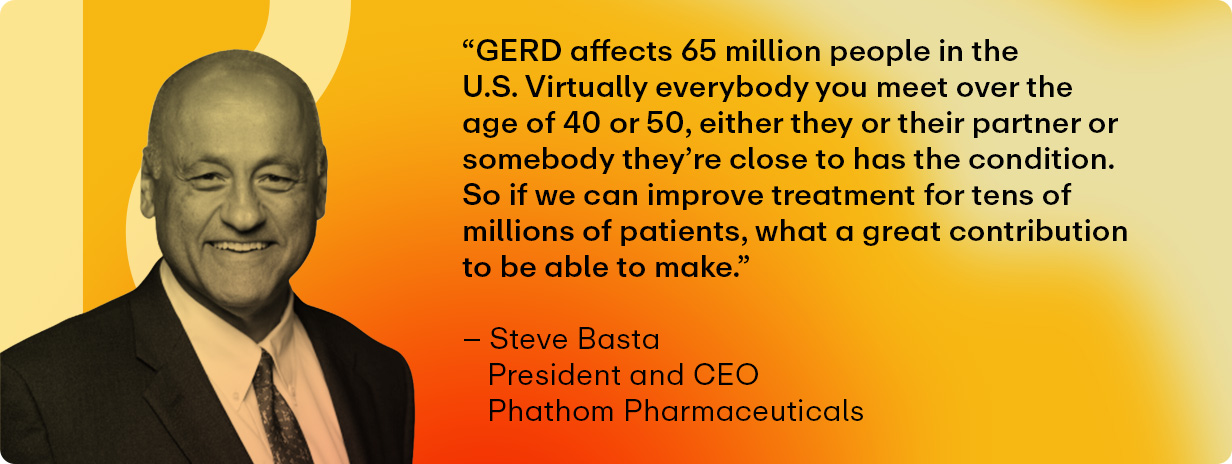
It’s about helping as many people as possible. There isn’t a bigger indication: GERD affects 65 million people in the U.S. Virtually everybody you meet over the age of 40 or 50, either they or their partner or somebody they’re close to has the condition. So if we can improve treatment for tens of millions of patients, what a great contribution to be able to make. That’s what initially captured my interest and drew my attention. Clinical data was terrific and the company was already getting traction. It was clear that physicians wanted the product.
What the company needed was to figure out how to do this profitably, and I enjoy commercial challenges. I enjoy building commercial organizations. It’s the thing I thrive on doing.
Feiger: What makes Voquezna so compelling for the treatment of GERD?
Basta: I personally have GERD. I switched to our drug around the time that I started with the company and, wow, it’s a totally different experience. I was on omeprazole for eight or nine years and I thought it worked. It actually reduced my heartburn. It didn’t get rid of it, so I had to adjust my lifestyle. I would sip wine very slowly; I would never eat spicy food. I’d get breakthroughs periodically and I’d add Tums whenever I did. I sort of got through the process.
Now it’s totally different. I put Tabasco on things. It changes your quality of life in a really meaningful way when you have the ability to get rid of the thing that’s causing you significant pain. And for GERD patients, it’s painful. People minimize it and say, “It’s just heartburn.” No, it’s really painful and it disrupts sleep and it has an enormous impact.
The standard of care in GERD hasn’t really changed in decades. People have been using PPIs for 20 or 30 years at this point, and that’s the best available therapy. But once you’ve been put on a PPI and doubled your dosing, there’s not much more that you can do. Now there is. If you’re still in pain, this is the right product for you to think about using, and that gets to our core commercial opportunity.
We don’t really think about our commercial opportunity being the 65 million patients with GERD, because 60 to 70 percent of those patients are adequately served on current therapy. But 30 to 40 percent of GERD patients are still in pain, and that’s who needs our drug.
One of the things we showed in a recent study is that there are fewer nighttime heartburn episodes if you are on Voquezna. So not only are you feeling okay every time you’re eating a meal, but when you go to sleep, as soon as you lie down, there’s a tendency for acid to travel from your stomach back into your esophagus. So if you don’t have as much acidity in your stomach, you won’t get as much irritation in your esophagus. It’s really simple.
Feiger: I want to dig a little bit deeper into what launch excellence really means, because I feel like the phrase has lost some of its meaning. What actually matters in a launch? What are the things you’re thinking about when it comes to a product launch in this type of category?
Basta: Our head of sales says it’s about being in front of the right customers and being excellent in front of them. That means having real clarity of messaging, clarity on the value proposition and clarity on how that customer is going to grow through their utilization. So first let’s make sure we’re in the right place and we’re talking to the right folks. That’s one of the things that we’ve done at Phathom over this past year: We’ve realigned who we’re calling on.
If you think about the GERD market overall, 80 percent of PPI scripts are written by primary care physicians and 20 percent of PPI scripts are written by gastroenterologists. So one might say, “Okay, this is a primary care product,” but that’s not actually true. If you think about the patient journey, where a patient who is still experiencing heartburn is going back to their primary care physician, getting double-dosed and then being sent to a gastroenterologist if they are still in pain, the patient who’s at the gastroenterology clinic is the patient who is in the most pain So that’s the right place.
Then let’s make sure we’re excellent in the way we’re calling on those customers. Let’s make sure our messaging is exactly right and clear for that customer, depending upon where they are in their adoption journey. The message that we’re going to deliver to a physician who has not yet written a script is very different from the message that we’re going to deliver to a physician who’s been writing scripts for all of their erosive esophagitis patients. We want them to start thinking about their non-erosive patients, who are still experiencing breakthrough pain. So deliver a message that’s appropriate for the physician at their stage of adoption. Deliver messages to the right physicians and make sure that you’ve got market access, which makes it easy for the physician to prescribe.
The dimension we put in place is not only do we have good payer coverage, where 80 percent of commercial lives are covered. But we also set up a partnership with Blink that enables a physician to write a script and know that their patient is going to get access to the product, so that we eliminate market access hurdles. If the product gets covered, the patient can get it with a $25 copay. If it’s not covered, they can access a $50 cash pay price. That reduces the barrier to adoption for the physician.
We’re doing some work right now to iterate and clarify our message and really hone it. We’ve got a new head of marketing who is doing good work around optimizing this message and delivering it in a more compelling way.
Feiger: As a follow-up question, which parts of commercialization do you believe can truly be systemized?
Basta: You can get to more systematic adoption of various elements of it. What I don’t see transitioning away from in this industry is the human-to-human contact of a rep in an office having a conversation with a physician – being able to read the hesitation points, being able to read the pause that happens when you’re talking about something and you go, “Doc, is that an area where you’ve got a question? How can we address that for you?” That skill set and that human contact are critical in how human beings make decisions.
We can automate all the emails in the world and we can automate all of the messaging and we can send non-personal-promotion kinds of things out, and we can make sure that we’re advertising in the places where physicians are looking for information. What we can’t replace is the in-person teaching that happens when a rep or an MSL is in an office, having a conversation with a clinician, really understanding their hesitation points and discovering that a-ha moment that gets them to think differently about how to use the product.
Feiger: How do you feel about digital and AI playing a complementary role in what’s happening today in HCP education?
Basta: It is absolutely where the entire industry is headed. And not just our industry, but literally every industry is headed toward thinking about integrating digital communications much more effectively in the sales process and in other areas. If you are selling a purely digital product, then purely digital promotion makes a lot of sense. In this case, the in-person communication is critical.
It is supplemented, as you described, with a series of digital and AI-driven enhancements. So we’re looking at AI as a facilitator of optimizing our sales calls and determining which physicians are likely to evolve in their journey of adoption and the key messages that are appropriate. How do you follow up a sales call with appropriate outreach to the physician? We’re looking at contact points that compliment the sales call, so that when you’ve got an interpersonal communication you can have the follow-up that makes it more memorable and cements the learning that was delivered.
How closely can you integrate those two? Those systems aren’t optimized yet, but we are at the front end of thinking about how to do that efficiently. It’s going to mean that a rep can see more physicians every week and have more impact. Maybe they do fewer sales calls to drive physician adoption, which creates much more efficiency in the system over time. There are plenty of physicians who can use our product, whom we can reach out to as we get more and more efficient in this process.
Feiger: If budget weren’t an issue, would you want an unlimited number of reps?
Basta: No, I wouldn’t. For example, we’re maxed out right now on the number of calls that we think we can make to gastroenterologists. Quite honestly, gastroenterologists don’t want a rep in their office more than once a week. That call can be more effective if we can add other touchpoints in other mediums.
With an AI agent, for example, you can imagine a world in which the agent is managing sample inventory in the office and is contacting the office to ask whether or not they have samples. Some of the stuff the rep is now doing that is more administrative in nature can happen more effectively. If we can free up 20 percent of our sales reps’ time, great. We can give them more targets and they can grow the business even more.
Reps spend a ton of time doing administrative work that they don’t need to be doing. I mean, how much time do they spend organizing lunches? The really valuable stuff is the conversation they’re having when they’re at the lunch. The valuable stuff is not figuring out how many people need to put in a lunch order and how to place the order and how to pick it up. That part could be automated with an AI agent so that the rep is in the office doing the really high-value stuff. We’re on the cusp of a transition that will improve efficiency in a meaningful way in the next two years.
Feiger: Running a commercial-stage biotech is fundamentally different from leading earlier-stage organizations. How has your leadership style evolved – not just for strategy but for capital deployment and revenue expectations and patient outcomes and everything else?
Basta: The operative word there is “leadership.” I don’t have to manage all this stuff. I need to set direction and I have the good fortune of having an extraordinary management team. Just on the commercial team, for example, our head of sales totally gets how to motivate a team and focus on delivering excellent outcomes in every sales call. Our new head of marketing is revamping our messaging and, candidly, brings deeper insights than I would ever bring to it. Our head of market access has done a rock-star job of making sure that we’ve solved the access problem for many plans.
So my role is providing direction. What is the direction in which we collectively want to go? What is the outcome that we want to achieve? I create that directional guidance and then allow our people to execute in their areas of expertise. Because across the entire organization, we’ve got folks who know their business and know their activities much better than I ever would. I just need to let them thrive.
Feiger: What advice would you give brand leaders trying to win in this environment, where there’s less tolerance for inefficiencies?
Basta: I don’t know that there’s universal advice for every brand in every category. For example, I don’t view our category as having any competition. We simply have a landscape where there’s a current standard of care, and what we are trying to do is find the patients who need to emerge from that standard of care to a new one with our product being introduced. Physicians have a 30-year habit of using particular products and we’re trying to change it.
Our landscape is very different from the landscape that a brand leader would have if they were launching a new oncology drug, for example, that had five competing products all trying to gain market share. For us, the key variable is understanding who needs our product, who is going to be motivated enough to seek out our product at the patient level and physician level, and for which patients does it solve the problem so compellingly that physicians are willing to go through the prior authorization requirement in a world where they can just write a generic omeprazole script and not have to do any work. You need to have the activation and energy to get over the hurdle that there’s gonna be a copay associated with our product. So where is the need high enough that physicians and patients will be motivated to overcome these hurdles? That’s what drove us to refocus the organization from a primary care audience.
Feiger: It’s been about five or six years since we first met. How are you thinking differently today versus then?
Basta: Clearly the market access rules are becoming more rigorous in the context of utilization management, as more drugs have been introduced that are creating a cost burden and a need to manage the utilization of those drugs. There’s a balance evolving as more products are introduced and more of that rigor gets implemented. And the industry is changing so rapidly with the adoption of AI around physician decision-making, in the prior authorization process, in marketing initiatives and in sales initiatives.
We don’t live in a tech world; we’re not doing software. We make physical drugs and distribute physical drugs to patients. But technology enablement is changing so many of the things we’re doing. We are taking our organization in real time through the realization of the impact it will have on our business.