As the global head of direct-to-customer innovation and digital health at BeOne Medicines, Anand Reddi has a broad remit over everything from the integration of digital technologies into patient care to the optimization of medicine delivery systems. Not surprisingly, the former Gilead and Adverum exec also oversees many of BeOne’s AI-related initiatives – which were a primary focus of his podcast conversation with Kinara’s Chase Feiger.
In this Q&A excerpt, Reddi discusses AI’s role in dismantling the information asymmetry that has prevented patients from acting as true partners in their care. He charts a path forward for the evolution of AI in the realm of oncology and shares his vision for the role of personalized AI agents in treatment.
(This Q&A has been lightly edited for length and clarity. To watch or listen to the full Kinara podcast with Anand Reddi, click here.)
Chase Feiger, M.D.: What separates the most successful entrepreneurs from those that don’t succeed?
Anand Reddi, M.D.: It’s a very complicated answer, but there’s this sort of founder mantra, this tenacity of never stopping and always asking questions and trying to figure out solutions and starting something and pivoting. That’s a skill set that you can’t learn in an academic setting. You just have to be wired that way.
There are two great biopharma entrepreneurs that I’ve had the privilege to get to know. John Martin was the iconic CEO of Gilead during the period when it discovered these life-saving treatments for HIV. He tapped that same playbook for hepatitis C. His secret sauce was the idea that it all tracks back to the molecule.
People come to leadership from many different pathways, but their fundamental foundational model of asking and answering a question – whether you’re a great entrepreneur/MBA type like John Oyler or a great medicinal chemist like John Martin, you have that same framework in mind. It’s a tried and trusted framework for how you approach problems, personal or business.
Then the tenacity, the grit – you have to have that. You can’t just give up. You have to have some focus, but also the ability to go where the innovation or the business model takes you. That’s when I think about the other great mentor in my life, John Oyler. In some ways, very similar to John Martin, he had a vision unencumbered by the orthodoxy of how things are done in the industry. In this case, it was biopharma and he questioned everything. That’s the other common denominator: You have to question everything, even the things that you think are foundational.
Feiger: How do you think John [Oyler] arrived at the decision to structure BeOne Medicines the way he did? How is that different relative to many other pharma companies?
Reddi: The previous company that John had was essentially a clinical research organization, so he recognized that the inherent challenges in drug development to meet global access were stymieing the industry. Innovation at that time would predominantly come out of industry and it would mainly just go to what were essentially considered the for-profit markets: the United States, Europe, Japan, a few other emerging markets.
When you look at the costs of drug discovery, it’s concentrated in those clinical development years when you’re advancing from phase one through phase three, and the predominant cost driver of that is clinical trials. So John recognized in 2010 that, if you truly wanted to change this quotient for clinical trials, you had to get out of doing trials just in the United States and Europe. You had to do them in places where you didn’t have as much volume, but you had access to great physicians, great healthcare and, obviously, patients in need.
That meant you had to do trials in places like Australia and Brazil and South Africa and Poland and China. Maybe instead of concentrating them in the key academic centers, you could go to trial sites that had the patients, but didn’t have the same high costs or were not as crowded as those premier academic centers.
He realized that you could get, at a bare minimum, a 30 percent cost advantage, a 30 percent time advantage and a 30 percent quality advantage. But you’re also building exposure with a bunch of folks who are essentially going to become the first users of your medicine. In some ways, by not concentrating on just academic centers and going into nontraditional sites, you all of a sudden get a very different aperture of end user at the earliest points of development.
The other aspect of it is on the discovery side. In 1995, as a young assistant professor at Emory, our other co-founder, Xiaodong Wang, discovered the five key proteins that were involved in apoptosis. He was a very famous professor and the youngest member of the National Academy of Science. He was a Howard Hughes Medical Institute investigator.
Then he was given an opportunity to come back to China. At the time, China was going through this renaissance where the country realized it wanted to be a leader in biopharma, similar to the United States. John [Oyler] met Xiaodong and they realized that, in addition to this vision of expanding broad access to life sciences innovation, they wanted to re-create that engine of discovery. What they did is what companies like Genentech and Chiron did in the late ‘70s and ‘80s, where you essentially took the innovation that was in academic or government labs and created an innovation model around it. That’s what gave rise to the early innovation of BeOne. BeOne’s DNA was anchored in building a global company.
Feiger: Everyone recognizes that, at some point, AI will play a pivotal role in bringing medicines to market. How do you see this affecting commercial innovation at a company like BeOne?
Reddi: It all starts with the molecule or the asset. You still have to do incredible science and something that’s differentiated and brings incredible value. And that, I think, is in our DNA, and it’s in our industry’s DNA. The industry, as you know better than anybody, is seeing more innovation. It’s getting to more patients than ever before.
There’s this idea that the historical focus of our industry was that the adoption of technology would drive research and clinical development. But we were a little bit reticent about how we embraced that technology for the end user, the patient and the healthcare provider, and how we leveraged technology to break down educational barriers, access barriers and frictions big or small. What is incredibly exciting in the age of AI, and particularly with the innovations that Veeva Ostro has championed over the last couple of years, is this idea that there’s so much information out there.
How do you make it even more accessible? And how do you go from having a static website where you have to spend hours to find that information to finding that information as fast as possible and then creating the next actions to make it even more accessible? All of the foundational models that you guys have built, where you’ve taken information and made it even more digestible and more actionable to impact the patient, are the starting point. Thinking about the additional modalities to make it even easier and to tether other actions to accessing the medicine, mitigating issues with insurance, addressing affordability, all of those types of things – that’s the next generation.
So I think it’s an incredibly exciting time, but it’s not going to be easy. What we can’t forget is that, while everybody sort of romanticizes this idea that AIs are going to solve everything, there’s still a responsibility to make sure that the information is as accurate as possible. That’s where building in these safeguards and starting to teach literacy and the basic framework of how to use this information – how to use it responsibly both from the patient and provider point of view – comes in. It’s analogous to when you and I were students, when half the battle was learning how to access this information and how to think about the inherent biases that are in the information, and then how to triangulate that information with other sources to arrive at the most holistic answer.
Feiger: Has anything you’ve learned about how AI will change or impact commercialization surprised you?
Reddi: At least in the context of agents that healthcare providers and patients are using, the foundational ecosystem is more or less the same. You know, they ingest information. It’s now incumbent on the industry to create tons of evidence to augment the product profile and also to educate patients. That crescendo of data generation, as well as a crescendo of patient communications, represents an inflection point for the industry.
In the past, at least from the patient side, there used to be a lot of information. But there was still an asymmetry. The information was stuck in academic journals that nobody had access to. Then we moved to open access. But even with open access, it took a high-fluency, highly literate person to understand that.
With AI, we now have the ability to take very complex information and simplify it and allow every single patient to be the CEO of their disease. And that’s incredibly exciting – and it’s something I personally still don’t realize the full promise and potential of. Clearly there is going to be a benefit. It will be incumbent on our industry and academics and researchers to document how these agents are improving outcomes, and use that to help us iterate.
On the physician side, there’s just so much information. Even if you specialize in a particular discipline, we’re getting to a point right now where every 30 days, we double our information, or something to that extent. The ability to synthesize that information and essentially have an AI agent do that meta analysis and systematic review, that’s a game changer as well.
But on the other side of it, the challenges are the information quality, the ability to mitigate misinformation, the ability for these agents to amplify misinformation. We need to start thinking through that. With AI agents, unfortunately, negative information can reverberate and boomerang just as potently as good information.
The collective call to action is that all of us have to stay vigilant. All of us need to ensure that if patients and providers are going to use these wells of information, we have to do a really good job to protect the public’s trust, to protect the public’s public health, to keep these sources as pristine as possible.
Feiger: Does AI enable a market of one, where every patient gets a custom-tailored commercial experience?
Reddi: I absolutely believe it does. The idea that we’re gonna move to a N of one, and we’re going to be communicating to the practice pattern of one physician in a particular ecosystem with a particular payer, I think that’s absolutely where we’re getting to.
I also think we’re going to move into a world similar to what we were talking about with patients, where there’s an accompanying AI agent that follows every bottle or pill pack or injector. Every physician will have an AI agent. And similar to how you have ChatGPT open on your personal computer and it’s learning from you, that agent will be the way that every physician ingests information and the way that my company and other companies will get into the system and help communicate the value proposition.
We’ll go from a market research campaign that takes you six to 12 months to figure out your physicians to just a single A/B testing where we take a Google-like or ChatGPT-like construct and, through their use of search, understand intention and background. For the first time, we’re going to have such precise understanding on that. The opportunity is huge.
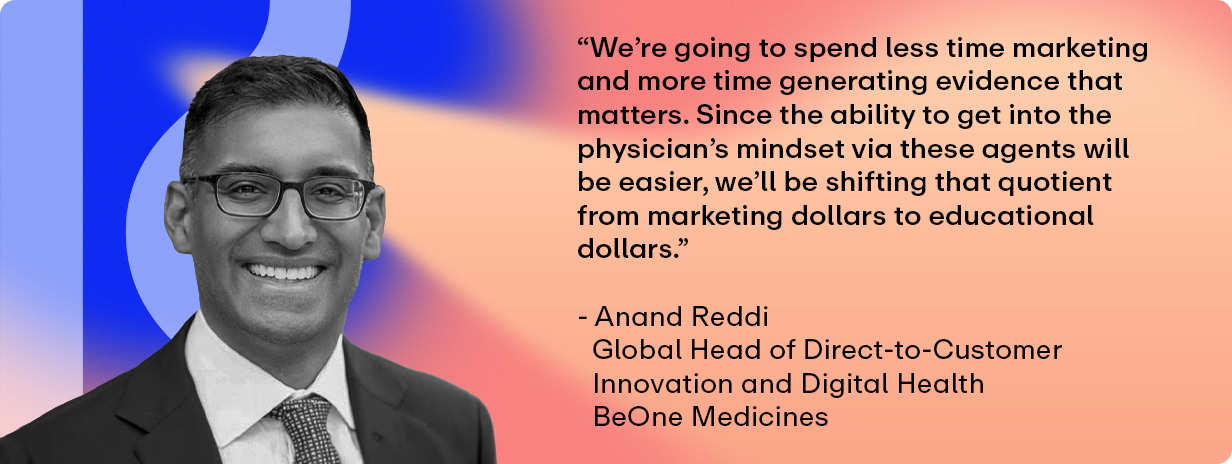
What I’m excited about is that we’re probably going to spend a little less time marketing and a lot more time generating evidence that matters. At the end of the day, since the ability to get into the physician’s mindset via these agents is going to be much easier, we’re going to be shifting that quotient from marketing dollars to educational dollars. Marketing then takes on a slightly different form. It shifts from building the fidelity of the brand to building the information to drive the brand.
Feiger: Instead of humans spending years in a lab testing “if X, then Y,” the AI CPU simulates trillions of protein folding instructions per second and can manipulate biological bits to solve the code of a disease before a pill is even pressed. When do we get to that future?
Reddi: What’s clear is that AI is going to be a very important tool to ingest lots of information, and that information is going to be very important in the discovery process. I mean, anybody who thinks the world is going to completely change overnight in the age of AI, I’m not sure about that. I think the innovation will still require the human mind – and 10,000 hours, if you’re a Malcolm Gladwell fan – but the AIs are going to augment that.
So we’re going to have, in many ways, a renaissance of innovation and discovery, but it will still be predicated on the hard work of understanding foundational and fundamental mechanisms in any discipline. This actually gives me great satisfaction, because the pursuit of mankind trying to understand everything and anything cannot change, and I don’t think it will necessarily be replaced. It will just be augmented. Certainly in the practice of medicine and the practice of research and discovery, we’re going to see some great things in the next decade.
The human mind is still more efficient and foundationally it will always be more efficient than any AI at any scale. We just need to remember that before we sort of reimagine the entire world, because that clarifies what AI’s role is going to be, particularly in healthcare. It’s going to be a tool. It’s going to help you make better decisions. But it’s not going to replace the connection between physician and patient. That’s the great take-home point for our industry in general.