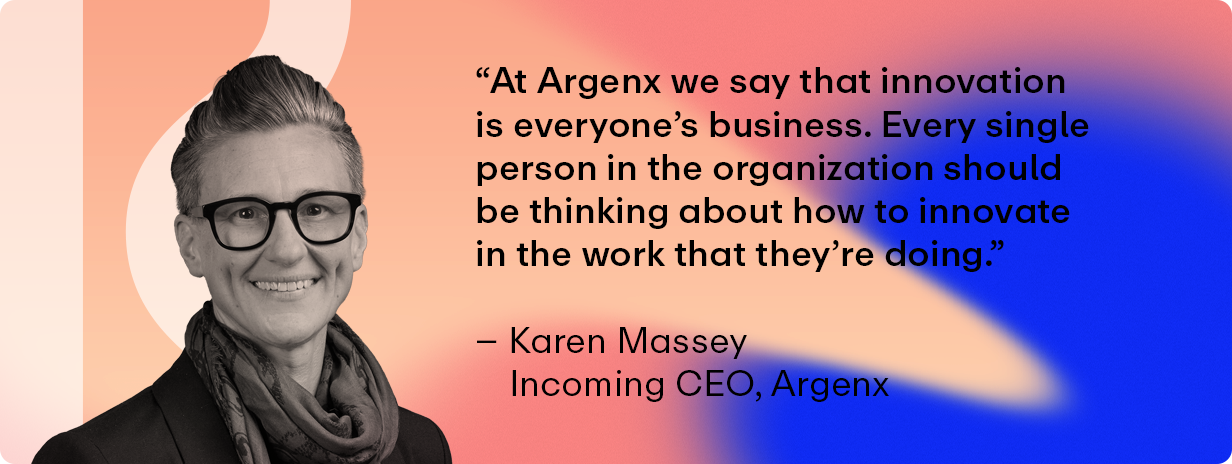
Two months before she was set to assume the coveted role of Argenx CEO, former Genentech and Pfizer exec and current Argenx chief commercial officer Karen Massey sat down with Kinara’s Chase Feiger to discuss innovation, leadership and inspiration. Over the course of their conversation, Massey framed innovation as an active, day-to-day imperative for every single person at Argenx, and shared the procedures and frameworks put in place to facilitate it.
(This Q&A has been lightly edited for length and clarity. To watch or listen to the full Kinara podcast with Karen Massey, click here.)
***
Chase Feiger: You’re stepping into the CEO role after serving as COO. How does your personal definition of innovation change when you move from operationalizing it on a day-to-day basis to being accountable for its long-term durability as CEO?
Karen Massey: I love the way you framed that question, because it’s around durability of innovation. It takes me back to the first conversation that I had with Tim [Van Hauwermeiren], our current CEO and co-founder. He and I, during our first conversation, aligned on something really important to both of us, which was that our objective and our goal was to build a company for the long-term and continue to innovate at scale over the long-term and stay independent because of that. From day one, it’s always been about, “How do we innovate in everything that we do and how do we scale our innovation?”
When we talk about that, we don’t mean just scaling innovation in terms of our reason for being, which is bringing more innovative medicines to patients over time. But it’s also about how we innovate in how we scale, how we work, how we bring these medicines to patients. How do we make sure that we don’t fall into the trap that we’ve seen many other companies fall into – that as they get bigger, they become hierarchical and bureaucratic and lose the ability to innovate? So for us, it’s always been tied together that, in order to deliver on our mission for patients, we have to be able to innovate at scale. There’s always an execution piece to that.
Feiger: What have you found to be the true limiting factors on speed and progress?
Massey: For me, what kills innovation is hierarchy and bureaucracy. It often comes with size that, all of a sudden, leaders within the organization – and, in fact, across the culture of the organization – start to become risk-averse. It protects what you have rather than creating something new.
You start to slow down because of that risk-aversion and also because you’re navigating all of these processes and SOPs and all of this stuff that’s put in place to manage the bureaucracy, rather than having people focused on the real thing, which is: What’s the next innovation? What’s the next big thing? How are we going to disrupt autoimmune diseases and bring incredible medicines to patients? We can do that in terms of the medicines and the molecules we’re developing, but also in terms of how we’re doing innovative clinical trial design to bring our medicines to market faster. It’s everything that contributes to the attitude and the culture, and leadership plays a big part in making sure that you retain that spirit.
Feiger: One thing I’ve observed across pharma is that innovation can sometimes be treated as a program, a function or a moment in time. From your experience, what does it actually take to make innovation a repeatable system rather than a series of isolated successes?
Massey: I like the idea of the repeatable nature of innovation. First of all, at Argenx we say that innovation is everyone’s business. Every single person in the organization should be thinking about how to innovate in the work that they’re doing, and that can be on the small scale or on the big scale. But it has to be more than just words.
And to your point about a repeatable system, for me it comes down to a few different pieces. One is you have to put the structure in place. For us, we landed on a team space structure that allows innovation to happen in these small cells or small pockets. If you have diverse teams that are well-functioning and focused on innovation, then you have one of the building blocks. So we’re all about scaling an empowered network of teams.
The second piece is that you have to teach those teams how to innovate and how to work together to effectively innovate. And then you have to create an environment where they’re encouraged and incentivized to do things in an innovative way. encouraging and rewarding experimentation. Especially in our early stage programs, we often ask, “How can we do the last experiment first?” We try to bring that to all parts of our organization so that our teams are not thinking in a linear fashion. If you put those pieces in place, then you can start to build these cells of innovation that are independent from each other and yet connected.
Feiger: How do you find the cohesiveness between these teams as information or knowledge moves from one group to the next?
Massey: That’s one of the hardest parts about operationalizing this. I would say we’re still learning and discovering how we can do that best. When Argenx started, and this is definitely before my time, one of the insights from Tim and the co-founders was to have the team follow the molecule for as long as the team members want to. So what you have is some consistency amongst the teams that move through the different phases. The other thing that’s really important is that, as you’re going from phase to phase, you make sure that all those different cells stay connected, and that’s where our network comes in. We try to use a very simple frame for this, where we have overlapping members on different teams who have the responsibility of being connectors between the teams. So we have an indication development team and an indication commercial team and they have overlapping members, who know what’s happening and can share the insights.
One of the things that stops innovation – and that stops information flow and transparency – is the formal structured communication that you often get in bigger companies. We use chat and we try to be in the office. We don’t mandate that people are in the office, but when they’re here we have those conversations and connect as humans. It sounds very lo-fi but it’s actually a huge enabler of innovation, because it spreads information more quickly. It brings more transparency. It lowers the bar in terms of how you engage with people and allows for more creative spark throughout the organization.
Feiger: How do you design decision frameworks that can help preserve accountability while still maintaining independence and enabling these teams to move with extreme urgency?
Massey: It’s a constant work in progress, especially as you’re growing. But there are a few different things that we’re thinking about. One is being really clear on the type of decision-making model that we have.
There’s a few different types. One of them is the authoritative decision-making model, where people at the top make the decisions – and those decisions end up becoming irrelevant, because the people at the top often do not get the best information. They’re not closest to the work. At the other end of the extreme, you have consensus-based decision-making. That’s a trap we’re trying to avoid, because it can often drift towards consensus and consensus often drifts towards average – and innovation doesn’t come from average. We’re not looking for average. We need more than that.
We have to actively fight against consensus. And so we use this consultative decision-making model, which is: Let’s be clear about who should make the decision, and that’s the person or the team that’s closest to the work. Indication teams should make decisions about their indication. Asset teams should make decisions about their asset.
But they have to be really clear about who they are consulting to make those decisions and who they are consulting to make those decisions faster and higher-quality. Sometimes it will be senior management, because the decision has implications for the company’s long-term success. The idea is that if there’s someone who’s impacted by the decision or someone who might have more or different information on the decision, then consult with them and right-size that amount of consulting based on how big the decision is.
Sometimes it’s easier just to ask the boss or just to go to the average. That’s not what we’re looking for.
Feiger: Where do you most often see disconnects between scientific innovation and commercial execution? How can leaders intervene earlier to ensure continuity from discovery all the way through delivery?
Massey: For me, it’s a function of these silos that emerge. We’ve all been in those companies. Where it goes wrong is when teams lose sight of, and the company loses sight of, a shared purpose. Generally, with any molecule, everyone’s purpose across the whole organization is to get that molecule to more patients faster. Yet we break that down in different functions into different measures.
So in development, it’s “hit this milestone as fast as possible.” Then in commercial, it’s about “I want to go to as many countries as possible and I want to have as many endpoints as possible, because then I can talk about all of the benefits.” But as a company, you break that down into what seem like meaningful metrics to measure people within those functions. And all of a sudden you create this disconnect, which can become bigger and bigger depending on how strong the incentives are and how you structure and all of that. It comes back to this idea of creating focus on the shared purpose that we have and creating diverse teams around it.
The indication development teams and indication commercial teams develop one plan together. There are different parts of the commercial plan and the development plan, but they ladder up to the same objective. That means they’re working toward the same outcome and, when the members get into a room together, they have the skills to talk out the pros and cons of both options. Or maybe we come up with “no, actually we could do this third option.”
You have to set that environment for teams. Otherwise it just becomes us versus them – which doesn’t really make sense to me, because we all have the same objective at the end of the day.
Feiger: How do you evaluate when a process is truly enabling innovation versus when it starts to suppress it?
Massey: Often process is the enemy of innovation. I think that’s because it’s trying to standardize and it’s trying to create efficiency. Look, some standardization is good and certainly in our industry it’s needed. So I want to be clear, we need processes. But we need to focus less on the outcome of standardization and efficiency and more on the outcome of enabling our teams to deliver high-quality data in their day-to-day work. Sometimes playbooks can be helpful for that. They can feel a little more flexible than having an SOP.
The process doesn’t make sense in 100% of cases. When you’re in a situation where teams are blindly following the process and something does seem to make sense, you ask them: Why are we doing this? And they say, well, I’m following the process. Is it because people don’t understand that, okay, the process is there, but you can deviate? Being a leader is about being engaged and asking those questions.
Feiger: What enables you to find your innermost important motivator and muse for innovation?
Massey: For me, it’s actually changed. One of the things is that I grew up in Australia, I moved to the U.S., I lived in London for a while and I now live in Switzerland. I learned so much by living in places where the culture is different enough that it makes you question things. And I think if you have the experience of being in different places that are really uncomfortable, you start to realize, “Oh, there’s all sorts of different ways to look at the world that I didn’t even know.” It starts to create different pathways in your mind.
But nowadays, because I travel so much for work, what I love is being in nature. It’s a different type of zen. I love hiking, I love cycling, I love skiing. Sometimes when I go away, I come back and look again at a problem that I didn’t think was solvable, and I find that I have different solutions. Somehow in my subconscious, my mind was working, but I needed to disconnect and I needed that time away.
Feiger: As we look ahead to when you take on the CEO role, what do you think is the most underappreciated responsibility of the CEO when it comes to sustaining innovation?
Massey: Just modeling the leadership behaviors that allow innovation to thrive. It can be really difficult for any leader, including the CEO, when you feel the pressure of having to deliver and execute every day – and by the way, every person in Argenx feels that way. Everyone asks the question, “But how do I do that and find time to innovate?” It’s about modeling those leader behaviors, not making the decisions that other people can make, even though it might seem easier in the moment.