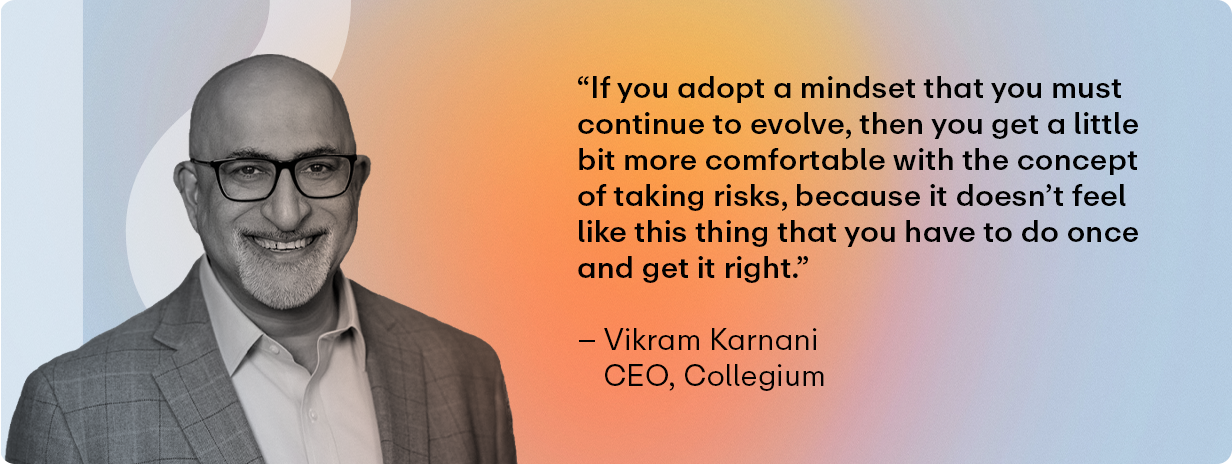
When Collegium Pharmaceutical president and CEO Vikram Karnani joined Horizon Therapeutics in 2014, he was a relative newcomer to the business. While he had consulted for a medical devices firm and spent some time working in cell therapy, Karnani was an electrical engineer by training.
That unconventional background (for pharma, anyway) has informed a leadership style that is equal parts bold, analytical and deeply empathetic. In this excerpt from his Kinara podcast conversation with Chase Feiger, Karnani talks about the need for educated risk-taking and the challenges that come with broadly deploying AI across a commercial organization.
(This Q&A has been lightly edited for length and clarity. To watch or listen to the full Kinara podcast with Vikram Karnani, click here.)
Chase Feiger: I want to start off with your background, because your journey started outside pharma. What was that journey like? How are you applying learnings from those experiences to the work you’re doing at Collegium?
Vikram Karnani: I was born and raised in India and I’m an electrical engineer by training. My late father was an electrical engineer and my mother is a retired anesthesiologist. So growing up, I had exposure to both the engineering side of science and the human side. When I was seven, eight, nine years old, I would follow my mom as she headed to the hospital for surgery. I didn’t understand a lot, but the one thing I could see was that, at the end of surgery, she was the one who was going to meet with the family of the patient. The impact of her words to those family members was very powerful.
So I worked in the engineering industry in R&D for a few years and got my MBA. I went into consulting and my first client was in medical devices, and I really enjoyed it. There is nothing more exciting or inspiring than going to work and thinking that everything you do is going to make an impact on somebody’s life. It sounds a little cheesy, but it is very powerful and very motivating.
I worked in medical devices for a few years, then in cell therapy for a couple more. Eventually I made the move into pharmaceuticals and the journey with Horizon started back in 2014. That led to the transformation of the company into a rare disease powerhouse. And here I am today, trying to make an impact within Collegium.
Feiger: The last time we talked, you noted that Horizon was not always a rare disease company. Tell me about how Horizon repositioned itself.
Karnani: When I joined in 2014, we were not a rare disease company. We were a company that was building a portfolio of nonsteroidal anti-inflammatory medicines. But we also knew that, as is the case in our industry, these medicines go through a life cycle – and we as a company were no different. We would need to do something, either extend the lifecycle of the medicines or add more products into the portfolio or make a strategic pivot into a new area. We would sit down as a team and talk about it: What is this next pivot? Where are we going to go? So in September 2014, we acquired Vidara Therapeutics, which had a medicine called Actimmune for CGD [chronic granulomatous disease].
I look back at it now and of course it makes so much sense. At the time, it felt like a whirlwind. Every six months or so, we were adding a new medicine into the portfolio. Before you know it, in a span of two years, we had created a very strong rare disease business, which had a significant amount of longevity left in its lifecycle. It was fascinating to observe us as a company, because on one side you had the business that was the foundation of the company, which appealed to tens of thousands, if not millions, of patients. And then the other side of the business, which was growing and was our future, was serving the needs of a couple hundred patients at a time.
The dichotomy was unmistakable. It wasn’t just about adding products to a portfolio; it was also about how we had to adjust and adapt our mindset to serving the needs of patients with an ultra-rare condition. We had to figure out how to operationalize this – not just in terms of how we brought the message to market, but what it meant for us culturally. It was perhaps one of the most rewarding times of my career, but I also learned a lot.
Feiger: When you think through your time at Horizon and the risk that the organization took in making these big acquisitions, what advice would you give to other CEOs?
Karnani: Taking calculated and educated risks is part of what we do. I mean, there’s the age-old saying about how you’re never going to score a goal if you don’t take a shot, right? The fact is that transformation is not a one-time activity. It is a constant. If you adopt a mindset that you must continue to evolve, then you get a little bit more comfortable with the concept of taking risks, because it doesn’t feel like this thing that you have to do once and get it right.
At Horizon, everybody was growing in the same direction. Everybody had the mindset of, “Look, we must take educated and calculated risk. We must take it and we must enjoy it, and we must learn from it.”
Everybody looks at the successes that we had at Horizon, but we had some stumbles along the way. I think we learned as much, if not more, from those stumbles than we then did from our successes. But the culture was one where you took that risk. If it didn’t work out, you didn’t make the same mistake again – but it was okay to make a mistake. You learned from it and took your best shot. Whether you’re a big company or a small company, that’s the mindset I would encourage leaders to have: Take calculated and educated risks. Celebrate the successes. Make sure there’s an environment where everybody knows it’s okay to take some risks.
Feiger: When it comes to applying that approach, what advice do you give to people who are working in more bureaucratic institutions?
Karnani: I don’t know if I would call that bureaucracy, Chase. Look, there’s a process that everybody must follow, right? Nobody’s going to go out there and make frivolous decisions about investment and taking risks. There’s a difference between bureaucracy and following a disciplined process, whether you’re a small company or a large company.
There are plenty of organizations where there’s a culture of being overly risk-averse. To me it’s more about establishing your threshold of risk – making sure everybody understands what you are willing to do, what you’re not willing to do, what type of risk you’re willing to take and what you’re not willing to take, and getting agreement on that upfront.
Back to 10 years ago, I remember sitting outside a regional sales meeting and [former Horizon president, chairman and CEO] Tim [Walbert] and I were talking about how, as a small company, you differentiate yourself when you’re in a business-development process. For us, it was with speed. Speed was a competitive advantage for us. We were successful time and time again because we could move fast and make decisions quicker, but it wasn’t because we disregarded other people’s input. It was because we had pre-established the risk we were willing to take and that allowed us to be very efficient – quick, but disciplined at the same time.
These are not perfect decisions. There’s a lot of individual assessment and judgment that is brought into them. So when you have a disciplined process with established parameters that people can agree upon upfront, it removes some of the bias or the emotion. It allows you to focus on the facts at hand, objectively.
Feiger: What advice would you give to chief commercial officers or chief marketing officers about going down the path to become CEO of a company like Collegium?
Karnani: People love the idea of being a CEO. You just have to go into it with eyes wide open, because it comes with a lot of responsibility and accountability. The role of the CEO in working and, frankly, being a facilitator with the board is really important. If somebody has had exposure to working with boards and the interaction between the CEO and a board and how the CEO works with the board chair, that’s pretty important.
There’s no book that kind of teaches you about this. It’s experiential. So if you have not had that exposure or experience, I would recommend that you talk to somebody about it and gain a better understanding. I spend a significant amount of time not just running the operations of the company or setting the strategic direction of the company, but also working with our board in all ways, shapes and forms.
A lot of choices that you make as a CEO or as a management team introduce an element of risk. The threshold of risk you’re willing to sign up for is really critical, because at the end of the day the buck stops with you. On a daily basis, I encounter situations, whether small decisions or large decisions, where I have to weigh risk every single time.
Feiger: How are you thinking about the application of AI across all areas of the organization? Are you mainly just focused on commercial and R&D?
Karnani: Everybody’s talking about AI, but I’m not sure people have figured out exactly what it means for them. What that tells me is that, before you start thinking about leveraging AI and solutions, you first have to figure out where you’re going to use it and what your needs are. How can it help?
We have sales forces that traditionally have figured out their routing. They know which physicians to call on and call on them with a certain level of frequency. Now, what if I told you that, based on a detailed analysis we were able to run, we can start to predict what that longitudinal journey for a patient could look like? That means I can tell my sales representatives that you shouldn’t come up with routing based on some unknown parameters; I need you to go to this specific physician because there’s an actual patient who is eligible for our treatment, and that patient will likely be visiting this physician at such and such point in time because they’re in this phase of their patient journey.
Now you can start to be a bit more intelligent and targeted with how you’re going to market, right? To me, that’s how we’re thinking about it. Now, the answer is not obvious because the longitudinal journey for an ADHD patient, depending on if you are a child or an adolescent or an adult, could look dramatically different. So it goes back to spending a lot of time analyzing available data sets and spending the time to understand the patient journey, and then thinking about how to deploy AI. That’s how we’re thinking about it. And I imagine there are other CEOs and leaders who are thinking about it the same way.
Feiger: How do you assess Collegium’s current trajectory, and what are the key inflection points ahead?
Karnani: I joined Collegium about a year ago. As I was doing my due diligence prior to joining, I talked with members of the board about taking on this role. The company has done extremely well; there’s a very strong financial foundation and a very strong commercial execution. Collegium is known as the leader in responsible pain management.
Coming into Collegium in 2024 was like going into Horizon in 2014. In both cases you had a thriving, strong business which had laid the foundation for future growth. At Collegium, that is the pain management business, which is extremely strong and highly profitable.
So we’re building off a strong foundation while having the desire as well as the fortitude to enter a new space. We’re entering a new area with the acquisition of Ironshore Therapeutics, which launched us into ADHD. So diversifying, while returning value to shareholders and strengthening the balance sheet – it’s a really compelling story that sets a foundation for a very bright future.
Feiger: What was the thought process behind the move from pain management into ADHD? Why was that the place where Collegium wanted to start, as opposed to other areas in the neuropsychiatric space?
Karnani: When you look at pain management and the world of CNS, psychiatry or neuropsychiatry are very logical adjacencies. But as you know, when you look into a new therapeutic area, it’s not just a matter of making that choice that you want to enter the space. You have to have the right asset available to you. I can say, “I want to go do gene therapy or cell therapy” or whatever. It doesn’t mean that I can just go and do whatever I want.
There has to be a product or an asset that is available at a size you can absorb and there has to be an actual unmet need that you feel you can fulfill. So a lot of ingredients have to come together beyond just wanting to go do something new – and all of those things came together for us with Ironshore Therapeutics and Jornay PM. We’ve owned the asset for a little over a year and we are absolutely thrilled with what we have seen.
We also see significant potential. When we took over Jornay, we saw an opportunity to expand the team, which we did: We expanded the team by more than 40% in April. And those folks have been out there promoting to psychiatrists as well as pediatricians. We’re adding new prescribers every single week. We’re growing the brand significantly. So a lot of what we believed pre-transaction has played out and is continuing to play out. I can’t wait to see how this transforms the lives of patients and caregivers over the next several years.
As I look ahead, that’s the type of transaction and business development we want to do. We want to bring in medicines that can make a difference, that fulfill an unmet need.